Guide
7 Skills You Need to Become an AI Engineer in 2026

Written By Liz Eggleston

Edited By Mike McGee
Last updated January 15, 2026
Written By Liz Eggleston
Edited By Mike McGee
Course Report strives to create the most trust-worthy content about coding bootcamps. Read more about Course Report’s Editorial Policy and How We Make Money.
Course Report strives to create the most trust-worthy content about coding bootcamps. Read more about Course Report’s Editorial Policy and How We Make Money.
As the definition of “AI engineer” continues to evolve, one thing is becoming clear: in 2026, employers aren’t just hiring for AI knowledge – they’re hiring for strong engineers who can apply AI thoughtfully inside real products. From integrating AI into web applications to making smart trade-offs around cost, reliability, and user experience, the role is far more product- and systems-focused than many job titles suggest. In this guide, Andrei Parfenov, Senior Curriculum Developer at TripleTen, breaks down the required skills, programming languages, and tools that actually matter for aspiring AI engineers.
Andrei has 9+ years of experience in software engineering, starting in front-end development (HTML, CSS, JavaScript) before moving into modern frameworks like React and Vue, and later full-stack work.
With a Computer Science degree and firsthand bootcamp experience, Andrei is driven by “combining the best parts of both worlds: a strong theoretical foundation and critical thinking from academia and practical skills from industry.”
He’s motivated by helping engineers reach the point where they can build real products that people actually use. “You’re solving real problems and delivering real value – that’s what makes engineering exciting.”
Andrei is developing the curriculum for the new AI Software Engineering Bootcamp
An AI engineer is a problem-oriented engineer. Their core responsibility is to recognize when AI makes sense in a given context – and, just as importantly, when it doesn’t. If a product or business problem can be meaningfully improved with AI, the AI engineer helps design and integrate that solution in a way that is reliable and aligned with real user needs.
At the same time, an AI engineer uses AI tools in their day-to-day software engineering workflow both critically and selectively. The role is not about treating AI as a silver bullet, but about continuously asking the right questions: Does this tool actually help in this situation? Does it improve quality or speed? What are the trade-offs?
In that sense, we talk about someone who builds products as a software engineer, understands AI well enough to turn it into practical value, and can clearly explain why AI is being used, what it contributes, and where its limits are.
The key responsibility of an AI engineer is to make AI features actually usable and valuable inside real products. This means understanding user needs, product constraints, and existing systems, and then deciding where AI can improve the experience.
Another major responsibility is integration and reliability. AI engineers working on web products need to connect AI services to front-end and back-end systems, APIs, and data pipelines, and make sure those features behave predictably in production. From a product perspective, AI is just another system dependency, and it needs the same level of engineering discipline as any other part of the stack.
Finally, AI engineers are responsible for judgment. They need to know when to rely on AI, when to put guardrails around it, and when a simpler, non-AI solution is the better choice. They work closely with product managers, designers, and other engineers to make sure AI features are understandable and aligned with real user needs. In practice, their value lies more in making sure AI works for the product.
There isn’t just one narrow role you should aim for. In practice, most careers grow out of strong product and software engineering foundations.
Entry-Level: A very natural path is becoming a product-focused Software Engineer who can build full-stack applications and thoughtfully integrate AI features where they add real value – for example, search, recommendations, automation, or intelligent user support.
Mid-Level: Another common path is moving towards roles such as AI-enabled Full-Stack Engineer or Applied AI Engineer. These engineers work at the intersection of APIs, data, and product logic. They design workflows, connect AI services to back-end systems, build reliable front-end experiences around them, and make sure those systems are safe in production.
Senior Level: Over time, these paths can naturally evolve into more senior roles such as Technical Product Engineer, AI Solutions Architect, or Engineering Lead. What really matters early on is not chasing an “AI-only” title, but becoming a strong engineer who understands products and users, and who knows how to use AI as one tool among many. That combination is already highly relevant today and will remain so as the technology continues to mature.
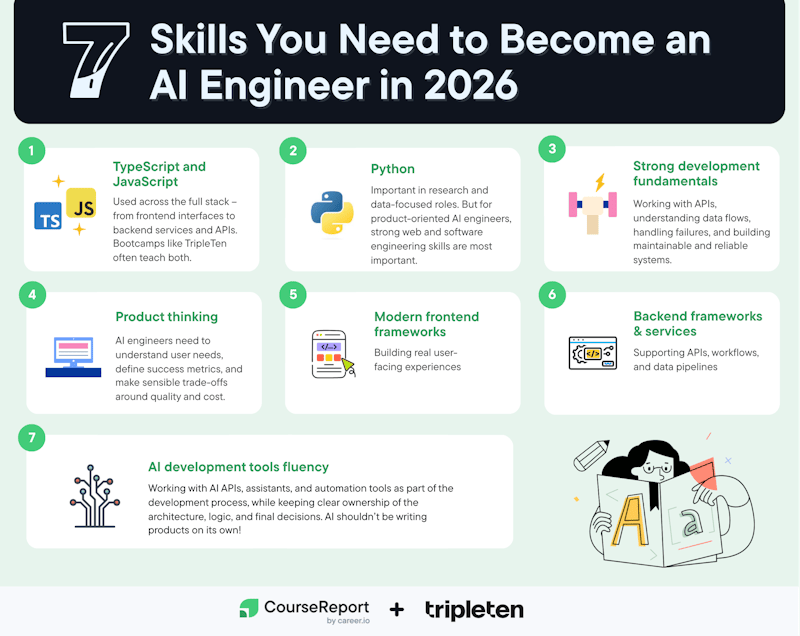
I don’t think there is a single “must know” programming language. Languages are tools, and the right one depends on the goal. What matters more is the problem you’re trying to solve and the environment you’re working in. Today, most products live on the web and need to integrate cleanly with existing systems.
TypeScript and JavaScript – The TripleTen program focuses on both of these languages. They are the core languages of the web and are used across the full stack – from frontend interfaces to backend services and APIs.
Python – Python remains important in research and data-focused roles. But for product-oriented AI engineers, strong web and software engineering skills are most important.
Strong development fundamentals – This includes system design, working with APIs, understanding data flows, handling failures, and building systems that are reliable and maintainable.
Product thinking is equally important – AI engineers need to understand user needs, define success metrics, and make sensible trade-offs around quality and cost. A key skill is knowing when AI adds value and when a simpler solution is the better choice.
Modern frontend frameworks – Building real user-facing experiences
Backend frameworks & services – Supporting APIs, workflows, and data pipelines
Fluency with AI development tools – This means working with AI APIs, assistants, and automation tools as part of the development process, while keeping clear ownership of the architecture, logic, and final decisions. AI shouldn’t be writing products on its own; engineers need to provide precise instructions, understand what the system is supposed to do, and critically validate the outputs.
Optional: As for MLOps and AI platform skills, their importance depends on the role. For most product-focused AI engineers, deep MLOps expertise isn’t essential. What matters more is the ability to deploy, monitor, and operate AI-backed features in production using solid engineering practices.
The ability to work effectively with AI as a collaborator is already important today, but by 2026, it will become table stakes. Engineers who can clearly define problems, guide AI tools with intent, and evaluate results in a real product context will stand out far more than those who rely on AI without understanding the underlying goals.
When you look at training programs preparing people for AI engineering roles, what signals tell you a curriculum is aligned with real hiring needs?
Right now, the role of an AI engineer is still very loosely defined. Different companies mean very different things by that title, and the same is true for training programs and bootcamps – the stacks, tools, and expectations can vary a lot. Because of that, the strongest signal of a curriculum aligned with real hiring needs is not how many AI tools it mentions, but whether it builds a solid engineering foundation first.
A strong curriculum focuses on fundamentals: software engineering principles, web development, APIs, data flows, system design, and how real products are built and maintained. Just as importantly, this foundation should be developed through hands-on work – not only theory, short exercises, or quizzes, but practical tasks that reflect real engineering problems.
Another important signal is whether the program teaches judgment. This includes understanding when AI makes sense, integrating it responsibly into products, and validating and maintaining AI-driven features in production. Curricula that emphasise real-world constraints and product thinking tend to align far better with what companies are actually hiring for.
TripleTen’s approach starts with strong fundamental engineering skills. We focus on core software development, web technologies, and systems thinking, so students build a solid foundation that remains relevant even as specific AI tools and frameworks change.
On top of that foundation, our programs are highly project-oriented. Students work on end-to-end projects that mirror how products are built in practice. Beyond the curriculum itself, students benefit from close support from industry-experienced instructors, as well as externships that provide hands-on experience with real-world projects.
We also prepare students for hiring expectations beyond technical skills. This includes developing communication and collaboration skills, practising through mock interviews, and learning how to explain decisions clearly. Finally, we teach students to use AI tools thoughtfully and responsibly – giving clear instructions, critically validating outputs, and being aware of risks.
Find out more and read TripleTen reviews on Course Report. This article was produced by the Course Report team in partnership with TripleTen.

Liz Eggleston, CEO and Editor of Course Report
Liz Eggleston is co-founder of Course Report, the most complete resource for students choosing a coding bootcamp. Liz has dedicated her career to empowering passionate career changers to break into tech, providing valuable insights and guidance in the rapidly evolving field of tech education. At Course Report, Liz has built a trusted platform that helps thousands of students navigate the complex landscape of coding bootcamps.

Mike McGee, Content Manager
Mike McGee is a tech entrepreneur and education storyteller with 14+ years of experience creating compelling narratives that drive real outcomes for career changers. As the co-founder of The Starter League, Mike helped pioneer the modern coding bootcamp industry by launching the first in-person beginner-focused program, helping over 2,000+ people learn how to get tech jobs, build apps, and start companies.






Enter your email to join our newsletter community.
